Magsafe N52 Permanent Ring Shaped Patch Permanent
Alignment, not pull force, decides a Magsafe ring
A Magsafe-style ring exists to align a phone to a charging coil, not to hold it up. That makes three things matter more than raw pull force: the inner diameter of the ring must clear the coil, the pole pattern must be symmetric enough that the phone self-centres, and the magnet must not lose flux as the charging assembly warms up.
N52 needs care here: its ceiling is 60 °C
N52 gives the highest flux of the sintered grades — measured remanence 1,420 mT, intrinsic coercivity ≥ 955 kA/m, maximum energy product ≥ 390 kJ/m³ — but its maximum operating temperature is 60 °C, against 80 °C for N35–N48. Whether 60 °C is enough depends entirely on how warm the charging assembly and the enclosure run in your product. Tell us the temperature your ring will actually see and we will hold N52, or step the ring to an H, SH or UH grade and accept slightly lower flux. The wrong answer here is to specify N52 by default and lose centring force as the device heats up.
Multi-pole arrays and Halbach layouts
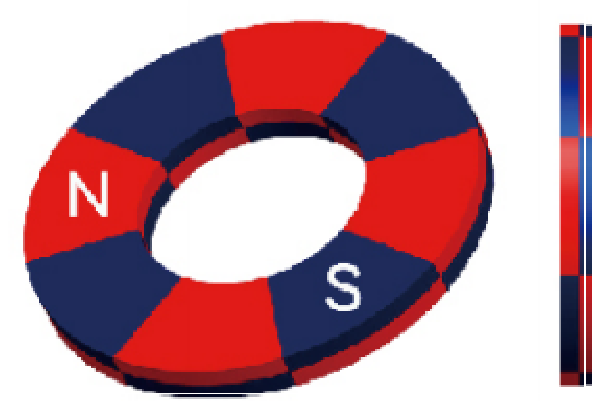
A charging ring is normally a multi-pole array rather than a single-pole ring: the magnetization alternates around the circumference so the field stays close to the surface and the phone is pulled into position rather than simply attracted. Radial, axial, diametral and custom multi-pole patterns are all available, and Halbach layouts are supported where the field has to be shaped rather than simply centred. We build dedicated magnetization fixtures for array work so pole positions repeat from part to part.
Dimensional control on a thin ring
Charging rings are thin, which makes flatness and inner diameter the two dimensions that decide whether the assembly closes properly. Standard tolerance is ±0.05 mm, with ±0.02 mm achievable on critical dimensions by grinding or wire-cutting, confirmed against your drawing before production. Quote on OD, ID and thickness — those three define the part.
Coating
Ni-Cu-Ni is the usual finish, because it is what a consumer product expects to see when the ring is visible. Black nickel, black epoxy and phosphating are also produced where the ring sits behind a coloured or matte surface. Salt-spray duration is quoted per coating across 12–96 hours.
Lead time and samples
Samples 10–15 days, small batches 20–30 days, mass production 40–60 days. In-stock samples are free — freight only. Send OD / ID / thickness, the coil clearance, the pole count and the operating temperature of the assembly, and we confirm feasibility within one business day.
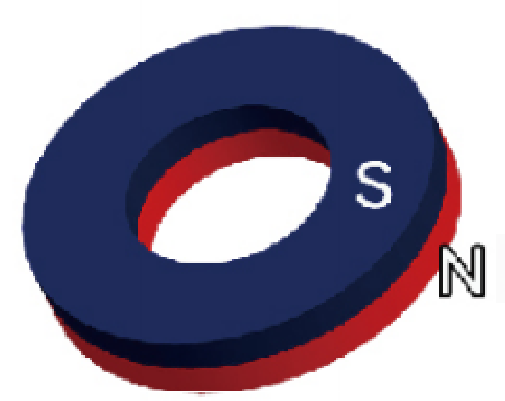
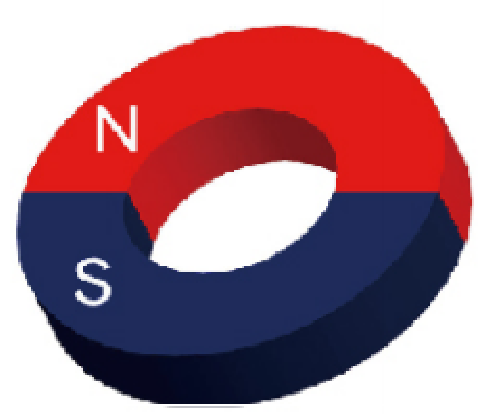
Available magnetisation directions — Ring magnets
The magnetisation direction is fixed when the magnet is magnetised and cannot be changed afterwards, so the direction must be confirmed before production.


Manufacturing capability & measured data
Tolerance
- Standard production
- ±0.05 mm
- Critical dimensions (on request)
- ±0.02 mm
Quoted per dimension against international dimensional quality standards, not as one blanket percentage. ±0.05 mm is the standard band; where a drawing calls for more, critical dimensions are held to ±0.02 mm using grinding or wire-cutting. The final tolerance is confirmed against your drawing before production.
Salt spray
- Duration depends on coating
- 12 – 96 h
Tell us how many hours your application needs and we match the coating to it. The test standard and the hours each coating reaches are confirmed on request.
Lead time
- Sample
- 10 – 15 days
- Small batch
- 20 – 30 days
- Mass production
- 40 – 60 days
Bands are by order type, not a single quantity threshold; exact lead time is confirmed at quotation.
Measured N52 properties
- Remanence Br
- 1,420 mT
- Intrinsic coercivity Hcj
- ≥ 955 kA/m
- Max energy product BHmax
- ≥ 390 kJ/m³
- Max operating temperature
- 60 °C
N52 has the highest flux of the sintered grades and the lowest heat tolerance: its maximum operating temperature is 60 °C, against 80 °C for N35–N48. For higher temperatures we move to an H, SH or UH grade and accept slightly lower flux.
Catalogue range and specialty grades
- Standard catalogue range
- N35–N52 (M–AH series)
- Specialty grade, on request
- N54 / N55
- Designation
- N54 (China) · N55 (international)
Related Products
- Magnetic Magsafe Ring Ring Patch Permanent
- Magsafe Magnet Wireless Charging N52 Neodymium
- High Precision N52 Transmitter End Magnetic Ring
- Custom Small Wireless Charging Magnet N52 N52h